 INVEST
 PLANT
PLANT
 SOFTWOODS
 HARDWOODS
 CALCULATORS
 RESOURCES
 REFOREST

Softwoods
Learn More




Understand why water is limited in drylands, how climate change and groundwater depletion intensify scarcity, and the strategies that restore water balance and long-term resilience
A complete guide to water scarcity in drylands, including why water is limited, how climate change and groundwater depletion worsen drought, and which solutions help restore water security.
Water scarcity in drylands arises when limited water supplies cannot meet the needs of communities, agriculture, livestock, vegetation, and surrounding ecosystems. Because these regions already operate near the edge of water availability, even minor shifts in rainfall patterns, groundwater recharge, or irrigation demand can quickly push them into severe water stress.
Water scarcity is rarely driven by a single factor. Instead, it develops through a combination of naturally low rainfall, intense evaporation, over-extraction of groundwater, and rising demand. Climate change is intensifying these pressures by altering rainfall timing and increasing temperatures, while inefficient irrigation systems and poor water management accelerate losses across agricultural and urban landscapes.
In dryland environments, water inputs are both scarce and unpredictable. Rainfall is often infrequent and uneven, and much of it is lost before it can be stored—either through rapid evaporation, surface runoff, or weak soil infiltration. When soils are degraded or compacted, their ability to absorb and retain moisture declines, reducing groundwater recharge and amplifying the effects of drought over time.
Drylands are landscapes where water availability is naturally constrained due to low precipitation relative to evaporation. They include arid deserts, semi-arid grasslands, savannas, shrublands, and dry sub-humid farming zones. These environments are highly sensitive to changes in water balance, making them particularly vulnerable to degradation when mismanaged.
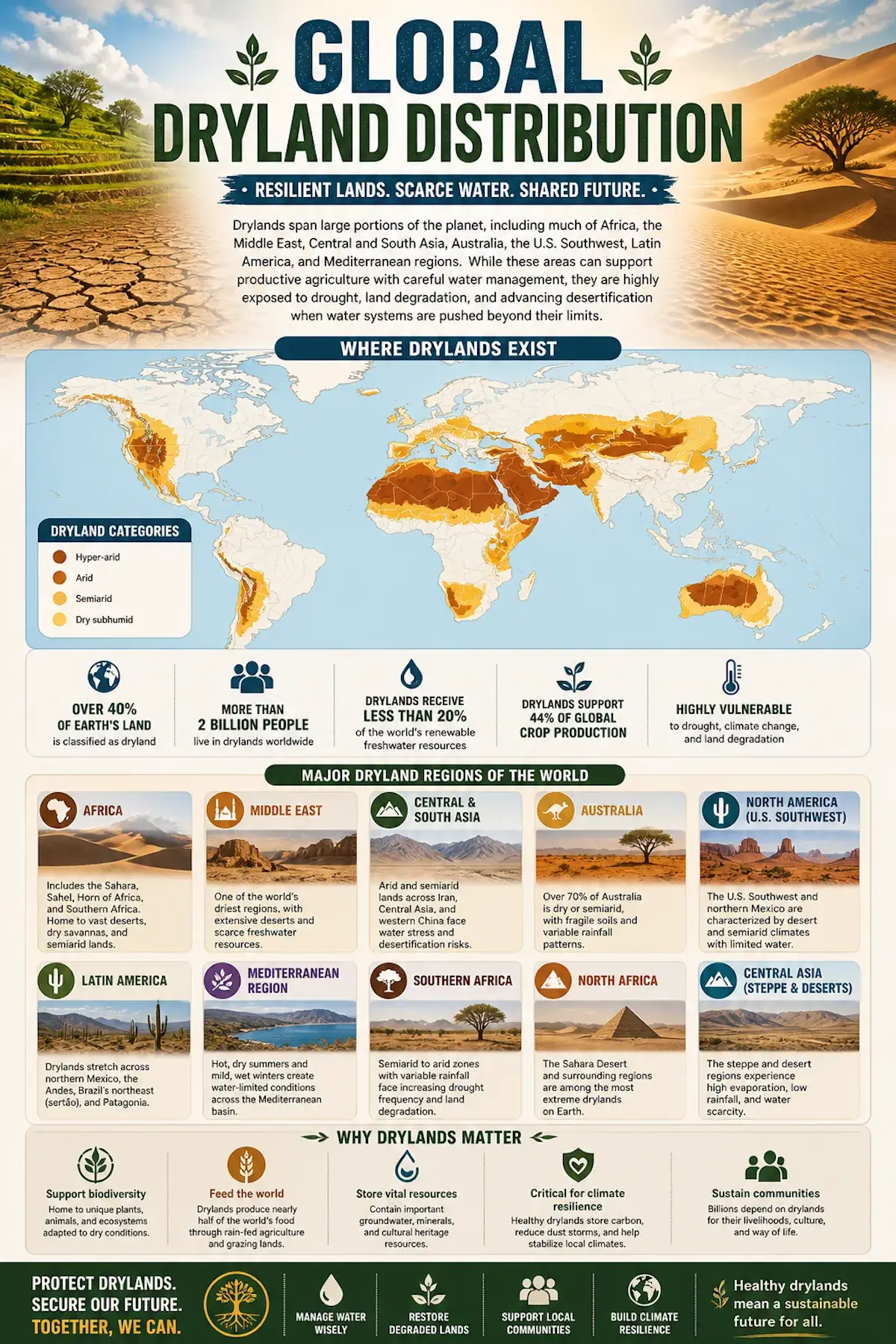
Drylands span large portions of the planet, including much of Africa, the Middle East, Central and South Asia, Australia, the U.S. Southwest, Latin America, and Mediterranean regions. While these areas can support productive agriculture with careful water management, they are highly exposed to drought, land degradation, and advancing desertification when water systems are pushed beyond their limits.
Feel free to share this global dryland distribution infographic explaining where drylands exist, major dryland regions, dryland categories, water scarcity, crop production, climate vulnerability, biodiversity, and why healthy drylands matter. Please include a link back to this page as the source.
Climate change is intensifying water scarcity by increasing heat, evaporation, and drought risk. In many drylands, rainfall is becoming more variable, with longer dry periods interrupted by intense storms that run off quickly instead of soaking into the soil.
Healthy dryland water cycles depend on vegetation, soil structure, infiltration, and groundwater recharge. When land is degraded, rainfall runs off faster, less water enters the soil, and streams or aquifers receive less recharge. This creates a cycle of increasing dryness.
Soil health determines how much water a landscape can absorb and store. Healthy soils with organic matter, roots, fungi, and stable structure act like a sponge. Degraded soils become compacted or crusted, causing rainfall to run off instead of infiltrating.
Water scarcity is one of the main drivers of desertification. When water becomes unavailable, vegetation declines, soil is exposed, erosion increases, and land productivity falls. Over time, once-productive drylands can become barren or desert-like.

Regenerative agriculture improves water security by rebuilding soil organic matter, increasing infiltration, reducing runoff, and keeping soil covered. Practices such as composting, cover crops, agroforestry, mulching, rotational grazing, and water-smart irrigation help landscapes hold more water for longer.
Water scarcity becomes far more dangerous when a dryland system crosses a tipping point. At that stage, water shortages are no longer temporary problems caused by a single drought season. They become structural failures in the way rivers, aquifers, soils, vegetation, farms, and communities function together.
In drylands, these tipping points can arrive gradually and then accelerate quickly. A falling water table, repeated crop failure, declining vegetation cover, or rising salinity may seem manageable at first. But once natural recharge, soil moisture, and ecosystem recovery fall below critical levels, the entire landscape can shift toward long-term degradation.
The most effective response is to act before these thresholds are crossed. Water harvesting, groundwater recharge, soil restoration, efficient irrigation, agroforestry, managed grazing, and drought-adapted cropping systems can help slow or reverse the feedback loops that turn water scarcity into desertification.
FAQ • WATER SCARCITY • DRYLANDS • DROUGHT
Water scarcity in drylands is the limited availability of usable water in arid and semi-arid regions where rainfall is low, evaporation is high, and demand often exceeds supply.
It is caused by low rainfall, drought, groundwater depletion, climate change, inefficient water use, and increasing demand from agriculture, cities, and industry.
Water scarcity is worsening because rising temperatures increase evaporation, rainfall is becoming more variable, groundwater is overused, and demand continues to grow.
People adapt through water harvesting, efficient irrigation, groundwater recharge, drought-tolerant crops, soil restoration, desalination, and improved water management policies.
Water scarcity can be reduced through conservation, recharge, better farming practices, improved infrastructure, and long-term watershed management, but solutions must match local climate and water conditions.
Copyright © All rights reserved Tree Plantation